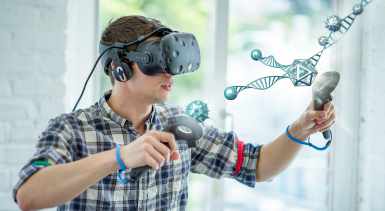
VR in Education: How Immersive Learning Is Changing Classrooms
Over the past century the basic principles of a classroom have remained unchanging: a front facing teacher with desks in rows and the use of chalkboards and textbooks as well as in recent years 2D screens. Although these techniques are effective however they struggle to make the connection between the abstract and concrete knowledge. Students are expected to think about the demise of the Roman Empire visualize the DNA double helix or remember complicated engineering concepts.
Now picture a different scene. An undergraduate student in history doesnt learn about the past of Rome as she strolls through the bustling large scale recreation of the Roman Forum. A medical student isnt content with an illustration of the heart he actually is holding a 3D beating virtual heart in his palms by rotating it in order to inspect each valve. The biology course is reduced into the shape of a blood vessel is transported through the circulatory system of the human body.
Its not science fiction. Its the future of VR for education..
Virtual Reality (VR) is fast moving away from its roots in games and entertainment and is now among the most potent and revolutionary tools of modern education. This transformation sometimes referred to as “immersive learning” represents the fundamental shift away from passive learning towards active and interactive participation. VRs potential VR in the field of education isnt just to enhance learning “fun” but to improve its efficacy engaging memorable and accessible.
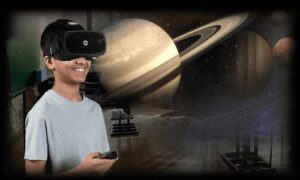
This article examines the significant effect of VR on education by examining the ways in which this technology has broken through the walls of classrooms its positive effects it has proven to have and the actual challenges that come with its use and the amazing future that it holds both for educators and students.
Read Also – Supervised vs Unsupervised Learning: Complete Guide 2025 | ML Algorithms
What Exactly Is Immersive Learning?
Before we get into its uses it is important to comprehend what makes VR for education is different from other forms of education. The key word here”presence.” “presence. “
Immersive learning is a method of learning which makes use of VR (and other related technologies such as Augmented Reality AR) to put the student in the environment of a simulation where they have the opportunity to engage. Instead of watching a movie or looking at pictures VR tricks your brain into thinking youre present. The result is an emotional and cognitive relationship to the topic.
- traditional learning: The student reads a informational text in a book (e.g. “A blue whales heart is the size of a small car”).
- Immersive Learning It is said that you “stand” next to a 1:1 scale representation of a blue whales heart and you feel physically dwarfed by it.
Another much more memorable impression is one which youll remember forever. It is “learning by doing” (or”learning by being” in this instance) “learning by being“) is the primary idea behind VR in education research has shown that it can lead to an incredibly growth in retention of knowledge as well as comprehension.
The New Dimensions of Learning: Key Applications
What is the role of VR being used in the classroom? currently being utilized? The possibilities are as wide as human imagination however they are generally categorized into certain categories that transform the teaching environment.
The Impossible Field Trip
Its the most acclaimed and widely used application of VR in the field of education. In most schools excursions are restricted by geography budgets and logistical. The excursion towards the Louvre is unattainable for classes living in the rural areas of Iowa. The Great Barrier Reef is impractical for… Well most people.
VR makes impossible achievable.
- Historical: Students can walk the trenches during World War I witness the official signing of the Declaration of Independence or visit the remains of Machu Picchu as they were at their best.
- Science and Geography: A class can walk at the top of Mars or dive down to the depths of the ocean and fly across the face of a storm in just an afternoon.
- Culture The virtual tours that are available of the most famous landmarks museums and other cities in the world are a great way to increase the global consciousness and foster cultural understanding like no textbook ever did.
The application of VR in the field of education does more than just enhance the syllabus; it rips the physical and financial barriers from the classroom.
The Risk Free Laboratory: Mastering Complex Skills
Certain skills are simply too complicated and expensive or even dangerous to learn in traditional schools. Thats where the virtual potential of VR for education is truly impressive.
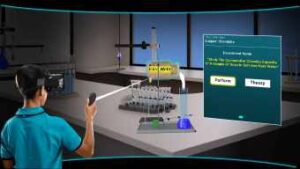
- STEM Students in Chemistry can perform chemical experiments that are volatile and take their lessons from mistakes (like an explosion in virtual reality) or try at a new level with absolutely no chance of harm. Physics students are able to manipulate the gravity field or imagine the abstract ideas of electromagnetic fields.
- medical training: One of the oldest areas that utilizes VR based the field of education. Nursing and medical students are able to learn complex surgical techniques and learn about human anatomy using real life 3D cadavers as well as practice high stakes emergency rooms scenarios.
- Vocational and Technical Training: Students can learn how to repair weld or join a jet engine or use large machinery in a created completely safe setting. The hands on training builds “muscle memory” that translates directly into the real world.
The Empathy Engine: Social and Emotional Learning
One of the most important applications of VR in the field of education is not with the hard sciences instead it has to do with humanity. VR can be an effective method to foster empathy and promote social emotional education (SEL).
Through letting a learner “walk in someone elses shoes” VR will help to develop perspectives and comprehension more effectively than lectures cant.
- The students can see their world through the eyes of someone who has disabilities such as an intellectual disability or sensory processing disorder. This helps them to comprehend their peers.
- Experiences in immersive journalism can put students in refugee camps or even a neighborhood affected by climate change. It can transform concepts of global concern into intimate emotions.
- VR can also be used to aid in learning soft skills like performing public speaking in front of a live audience or even navigating tricky discussions in social settings.
Creativity and Conceptualization
For subjects that are abstract VR in education renders intangible things real.
- Mathematical: The students can explore 3D geometric shapes or even visualize intricate tasks.
- Art and Design: Art students can create art or sculpt within a virtual 3D environment and have an unlimited supply of equipment and supplies.
- Literature Think of a child who is not just studying Hamlet and standing on the stage in the Globe Theatre watching the production unfold in front of their eyes.
The Evidence: Why VR in Education Works
It sounds amazing But is it really useful? It is becoming increasingly evident and the answer is yes. The advantages of VR for education arent just personal but they can be measured.
Unprecedented Engagement and Motivation
One of the most obvious benefits a teacher can see when they introduce VR into the classroom is an enormous increase in the level of engagement among students. In this age of electronic distractibility VR commands a students total and complete focus. VR is an active rather than a passive learning experience. The students are “leaning in” excited to discover and are the initial and foremost step in an educational success.
Dramatic Improvements in Knowledge Retention
It is the most crucial measurement. If you consume information in a passive manner (like lecturing or reading) retention rates are generally lower. If you learn through practicing the rates increase dramatically.
A groundbreaking study from PwC revealed that those who had been who were trained in VR:
- is 4 times faster to learn than a traditional class.
- 275 percent more assured when applying the new abilities.
- 3.75x more emotional connected to the contents.
- four times more concentrated when they train than their E learning counterparts.
Although this was an investigation for an enterprise but the concepts are universal. Immersive interactive aspect of VR for the field of education can create better neural pathways and helps transfer knowledge from short term memory into the long term perspective.
Personalized and Accessible Learning
VR for education offers the ability to adapt to the individual needs of learners. Students who struggle in reading textbooks may do well within a tactile hands on virtual world. Additionally it permits students to learn on their own. If a student doesnt grasp a concept may restart the simulation to test it over and over without the judgement or stress of a real class.
The program also has great potential for children with disabilities as it provides an environment that is safe secure and repeatable space for them to develop social skills or academic subjects in a manner which is adapted to their needs.
The Reality Check: Hurdles to Adoption
If VR in education is truly innovative then why doesnt it exist present in every class in the present? Similar to any other transformative technology its journey is full of major practical issues.
The Digital Divide: Cost and Infrastructure
The biggest obstacle is price. Even though headsets that are standalone have become cost effective the expense of outfitting the entire classroom or even an entire school district is an enormous capital expenditure. It includes:
- The hardware: Sets of headphones for 30or more students.
- The Infrastructure High bandwidth robust Wi Fi that can handle all of these devices.
- Maintenance Broken headsets require charging and continuous IT help.
Theres a risk that VR in education could increase this “digital divide” giving the most privileged schools a distinct benefit over those with lower resources.
The Content Gap
Hardware can be useless without high quality software. This is known as the “chicken and egg” problem. Teachers will require a wide collection of VR experiences that go beyond only “cool” but are:
- curriculum aligned directly mapped to certain standard of learning (e.g. Common Core NGSS).
- Pedagogically Sound It was designed with the learning sciences in mind and not only to entertain.
- User friendly: Teachers do not have the time to become IT manager.
The content library is currently developing but its a lengthy and costly procedure. The success long term of VR for education relies on the community of educators and creators. publishing.
Teacher Training: The Human Factor
It is not enough to simply throw an entire container of VR headsets into a class and then expect to see magical results. Teachers are and will always be the primary factor. A successful implementation of VR into education will require a different way of conducting lessons.
Teachers require time and the most important professional growth to be able to:
- What is the best way to use this technology.
- How do you integrate a 20 minute VR experience in a 50 minute lesson strategy.
- What is the best way to handle a class in which half of the students are “in world.”
In the absence of teacher participation and education the most costly VR for education program can get buried in a closet.
Health Safety and Ethical Concerns
There are also human factor problems.
- “VR Sickness”: Some users suffer from motion sickness and eye strain.
- Screen time: Teachers and parents are concerned with the increase in the amount of time spent on screens.
- data privacy: The issue is huge urgent problem. When a classroom is virtual What data are recorded on the child? Head movements? Eye tracking? What is their “look”? Every VR based education platform needs to have strict and transparent privacy guidelines.
The Future of VR in Education
In spite of the difficulties however the path is clearly. Technology is quickly becoming higher quality more affordable and more lightweight. What lies ahead for VR in the field of education is not in the realm of when or when but how and when.
Whats happening in the near future:
- AI Integration Its the game changer. Imagine an online tutor driven by AI which can communicate with the student in real time. A virtual history simulation in which the AI powered characters (like an Roman senator) will respond to students inquiries.
- The “Metaverse” as a Global campus: The vision of VR in education is a recurring globally connected learning environment. Students in India can work on the same project using a virtual scientist with students from Brazil as well as Japan and meet with them in a virtual lab shared by all.
- AR as well As mixed Reality: As hardware changes the distinction between VR (fully immersive) and AR (digital objects found in the actual world) is likely to blur. Students might be able to be able to look at their desk and then see a digital 3D image of a frog for them to look at which combines two worlds.
Conclusion: The Classroom Transformed
VR in the field of education does not provide a silver solution. It cannot replace the essential role played by the best teacher. The headset cant inspire students run classrooms or give an individual mentorship.
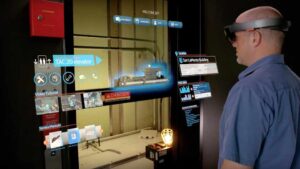
However what VR in education will do is supply educators with the most efficient educational tool that has been invented in the past since printing presses. Its a method to stimulate curiosity create a deep and long lasting understanding and also to provide students the opportunity to experience things otherwise unattainable.
We are moving from an information based economy to a skills and experience based one. The future belongs to people who are able to think critically and solve difficult problems and be able to empathize with others. With VR you can provide a place that allows for safe practices of deep exploration as well as the human experience VR in education does more than just transform the way students learn it is also creating the foundations for that new the future one immersive moment at a. The use of VR for education is not a flimsy trial; its an important step towards.