
Top 7 Cloud Computing Trends Reshaping Businesses Guide in 2025
In the last decade the corporate world was defined by a constant shift to cloud computing. One of the most important questions for many businesses consisted of “How do we get to the cloud?” The question of 2025 has become outdated. Cloud computing is not an endpoint its the standard operating system of modern enterprises and the primary nervous system that connects all aspects of digital first businesses.
Presently we are faced with an entirely new and more complex collection of challenges. How can we handle the ever growing complexity of our cloud infrastructures? How can we manage the increasing cost? What can we do to secure the security of a boundary that has been shattered? In addition what can we do to transform the cloud from an unimportant service into an engine that can generate true intelligence and ingenuity?
The answer lies in the next major advancement that is cloud computing. Were moving away beyond the era that was characterized by “cloud adoption” to an time that is characterized by “cloud optimization” and “cloud intelligence.” The change isnt slow; its an enormous disruption caused by a fusion of numerous forces. Artificial intelligence is maturing and the explosive growth of connected device data as well as the unavoidable requirements of sustainability and security have created a brand new environment.
This article will be your ultimate overview of this changing landscape. Well conduct an in depth study of Top 7 Cloud Computing Trends Reshaping Businesses in 2025. going beyond buzzwords to give a comprehensive overview of the key elements what they mean how important they are today and how they could profoundly alter your processes product offerings competitive strategies. Theyre not just isolated incidents as they are inextricably linked factors that will determine the winners and losers over the next decade.
Trend 1: Generative AI Becomes the Core Fabric of Cloud Platforms
One of the most talked about and transformative future trend for 2025 is in no doubt the extensive and seamless incorporation of Generative AI in the cloud. Its not an issue of AI as a distinct specialization; it concerns Generative AI becoming a fundamental element within the cloud stack itself.
What It Is
Generative AI which is the tech behind models such as ChatGPT as well as Googles Gemini is now available in a variety of ways not just as an app but as a fully managed platform service which is what some call AI as a Service (AIaaS). Major cloud suppliers (Amazon Microsoft and Google) are engaged in an arms length race provide the extremely powerful Large Language Models (LLMs) as well as foundation models available via easy API calls. Services such as AWS Bedrock and Googles Vertex AI Platform and the Azure OpenAI Service have evolved into prominent products which allow companies to develop tweak and then deploy advanced AI models without huge infrastructure costs.
Why Its a Top Trend in 2025
Although Generative AI exploded into public awareness in 2023 in 2025 it transitions from an experiment into a large scale deployment. Its “why now” is threefold:
- Accessibility A model that is driven by APIs makes access more accessible to. Anyone can now incorporate the worlds best AI in their apps.
- Mature Models that are robust reliable and adaptable to particular business situations (e.g. by using an organizations data for tuning).
- AIOps: Cloud platforms are making use of GenAI for self managing auto optimize and self heal. It is known under the term AIOps (AI for IT Operations).
How Its Reshaping Businesses
Generative AI using cloud computing is an all encompassing disruptor and is among the top 7 Cloud Computing Trends Reshaping Businesses by 2025 for the reason that for itself.
- Operational Impact: Were experiencing the growth of “co pilots” for every business job. AI powered assistants can be found in Code editors (like GitHub Copilot) to speed up development within CRM tools for drafting sales messages within finance software that analyzes reports and security dashboards for describing threats using natural languages.
- Strategic Impact: Businesses are developing completely new “AI first” products and services. It includes highly personalised customer support bots that solve difficult problems R&D platforms that can create new drugs and marketing engines that create whole campaigns with one single request.
- Financial Impact Financial Impact: The ROI could be huge and is driven by dramatic gains in efficiency. But this trend introduces a new and volatile cost vector. Artificial Intelligence “inference” (using the model) is a hugely expensive process and makes the cost control concepts that are part of FinOps (Trend 3) more crucial as never before.
Problems: The most significant hurdles include balancing the high expenses maintaining data privacy as well as security (especially when working with private data) and dealing with through the “black box” nature of AI and its potential to “hallucinate” or produce biased results.
Trend 2: Hybrid and Multi Cloud Is the Default Permanent Strategy
In the past “hybrid cloud” was thought of as a temporary step up a solution to allow legacy businesses to in the future to move “all in” on a single cloud. By 2025 the idea has been discarded. Multi cloud and hybrid architectures have become the standard planned strategic and deliberate option for the majority of multinational enterprises.
What It Is
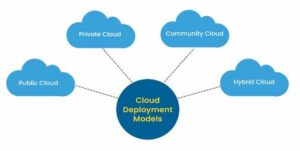
- Hybrid Cloud: A smart mix of private cloud (on premise infrastructure) along with at least one or two cloud services available to the public (like AWS or Azure).
- Multi Cloud: Making use of services provided by several cloud service providers (e.g. AWS for computation Google Cloud for AI as well as Azure to support its Microsoft 365 integrations).
In 2025 all big companies will be at least one of. They have an internal cloud to support essential systems and use the multi cloud model to handle everything else.
Why Its a Top Trend in 2025
“The “one cloud to rule them all” idea has proved to be a fable. In reality businesses require a variety of complex and non negotiable requirements that no single service provider can satisfy. This trends drivers are now essential business requirements.
- Data Sovereignty and Compliant Data Sovereignty and Compliance: This is the primary driving factor. The GDPR (Europe) CMMC (US Defense) and a myriad of other law governing data localization require specific information to be kept on premises or inside a certain area making the use of a cloud that is completely public difficult.
- Beware of Vendor Lock Ins C suite executives are acutely aware of being reliant on one vendors pricing as well as terms and techniques. Multi cloud solutions offer an opportunity to leverage the power of multiple cloud providers and allows for greater flexibility.
- Best of Breed Function: Companies can use its strategic thinking to “cherry pick” the best service of each service. It could use Googles Vertex AI for machine learning and Azures S3 to store data and Azures Entra ID for identity management.
How Its Reshaping Businesses
This shift in the IT industry is forcing a radical transformation in ITs function that shifts ITs role shift from “provider” to “broker.”
- Operational Impact: The main problem is the complexity. IT departments are now required to navigate a complex set of various applications tools APIs and models for security. It has resulted in a booming marketplace for cloud orchestration platforms as well as “control planes” like Google Anthos AWS Outposts and Azure Arc. They provide an “single pane of glass” that can manage all workloads on cloud platforms.
- Strategic Impact: Businesses are able to today optimize their workloads according to costs performance as well as conformity. The bank is able to run its live trading app using a low latency cloud and run its mobile application on a highly scalable cloud that is public.
- Financial Impact: Although cloud computing can help you save money however it can also result in additional inexplicably high expenses. Fees for data egress the price that you have to pay for moving information out of cloud storage can be astronomical and should be managed carefully.
Problems: The most significant obstacles is the sheer complexity of operations as well as a dispersed security strategy (see the trend 5) as well as the urgent necessity for a fresh collection of the management and orchestration of cloud services across all clouds.
Trend 3. FinOps Changes From Cost Control to Business Value Optimization
The direct and inevitable consequence of the multi cloud hybrid expansion is the growth of FinOps. Since cloud based computing is one of the biggest costs of operations for a lot of companies “bill shock” is an important C suite issue. FinOps is an enterprise wide solution.
What It Is
FinOps which is also known as Cloud Financial Operations is far more than “cost cutting.” Its a way of life and set of practices that bring together finance engineering IT and management to control cloud based spending. It is the goal to increase the value to business of each cent spent on cloud. This involves data driven expenditure accountable real time decisions.
Why Its a Top Trend in 2025
When the cloud first came into the cloud expenditure was an centralized IT budget line item. Nowadays thanks to autonomous development teams serverless features (Trend 6) and pay as you go GenAI model (Trend 1) Costs are distributed as well as dynamic and difficult to anticipate. 2025 is when FinOps will become a continuous business process much as Accounting or HR.
How Its Reshaping Businesses
FinOps creates a new system of financial accountability in engineering.
- Operational Impact: This drives the development of high end artificial intelligence driven FinOps platforms. They offer real time insights of cloud spending breaking down the cloud spend by team and project or feature. They utilize AIOps in order to detect and remove waste like “zombie” servers (idle resources) and databases with too much provisioning and storage that is abandoned.
- Strategy Impact FinOps transforms the discussion that was “How much are we spending?” and shifts the focus to “What is the value of our spend?” Cloud costs are linked to company KPIs. Instead of a simple cloud bill managers will be able to view the “cloud cost per customer acquired” or “cloud cost per transaction.” This is a way to make a decision making process: “Is it worth paying 10% more for our database to get a 200ms faster page load which we know increases conversion rates?”
- Financial Impact: Companies have developed sophisticated cost control methods such as “showbacks” (showing teams their expenditure) as well as “chargebacks” (making them pay the cost out of their budgets). This provides a strong incentive for programmers to create effective “cost aware” code.
Problems: The biggest problem is the impact of cultural changes. FinOps is about breaking down the boundaries between engineering and finance that are usually in conflict with each others culture. Also it requires innovative mixed “FinOps Engineer” skillset that is scarce.
Trend 4: Edge Computing Extends the Cloud to the Physical World
In the last two decades cloud has focused on centralization. Its about bringing all of the data we have and processing in only a handful of massive high performance data centers. By 2025 the model will be flipped. Edge Computing is about moving computing storage as well as AI away from the central cloud closer to the places where data is produced and consumed.
What It Is
“The “edge” is any computing which takes place outside of the conventional data center. It could happen within a factory or retailer in a vehicle or using a mobile phone. Edge computing stores the data locally in or close to the device instead of sending everything to the cloud to be analyzed.
Why Its a Top Trend in 2025
This is an immediate answer to the physical limits of a cloud that is centralized.
- The IoT Explosion The huge quantity of information generated through billions IoT equipment (factory sensors cameras with smart technology and health monitors) is simply too huge to be sent to the cloud. This would engulf networks and would be prohibitive to pay for.
- There is a Need for Real Time: The physical laws. When it comes to applications like an autonomous vehicles brake system as well as a factory robots security stop or an AR aided surgery The delay (delay) of a round trip into the cloud would be inexplicably slow.
- 5G deployment: Broad 5G offers the highest bandwidth low latency network required for the connection of these advanced edge devices. It makes the development of complicated distributed apps possible.
How Its Reshaping Businesses
Edge computing serves as the vital connection between physical and digital worlds that makes “real time” business a reality.
- Operations Impact: When manufacturing edge devices that have built in AI will perform in continuous quality control in real time at an assembly line notifying defects immediately without the clouds latency. Retail store cameras are able to analyze foot traffic patterns of shoppers and replenish shelves with no impact on the internet connectivity of the store.
- The Strategic Implication: This allows completely different model of business. Remote mining autonomous driving operations smart grid energy management and live monitoring of patients in real time are just a few examples of “edge native” businesses. Additionally it improves the resiliency of apps when the connection to central cloud is lost but your local “edge” can continue to function.
- Economic Impact: This lowers expenses by cutting bandwidth and charges for data transmission. Instead of streaming video 24/7 from a hundred security cameras edge devices process video locally and sends an alert of 5 seconds to the cloud in case it spots an abnormality.
The challenges: Edge creates a new huge security and management issue. How can you effectively monitor update and control 50000 devices spread all over the world? That makes an unified system of security and coordination (Trends two and five) extremely important.
Trend 5: Security Unites into AI Powered Zero Trust Platforms
The sputtering fragmented and dispersed characteristics of hybrid cloud multi cloud edge and hybrid environments have rendered conventional security strategies obsolete. The notion of an “castle and moat” perimeter is a comedy as it is true that the “castle” is scattered across five cloud services thousands of edge devices and many SaaS applications.
What It Is
The solution to this unrest is a double pronged revolution in security which makes it among the top 7 Cloud Computing Trends Reshaping businesses in 2025.
- Zero Trust Architecture (ZTA) Security model based upon the concept of “never trust always verify.” It is based on the assumption that there are threats within and outside of the network. Each device user as well as application needs to constantly authenticated and verified prior to entering any resources.
- Cloud Native Application Security Platforms (CNAPP) is a shift away from the dozens of security tools that are fragmented (one for programming and networks another for network security another for authorizations) towards a single integrated platform that covers every aspect of cloud security. This includes:
- CSPM (Cloud Security Posture Management) detects configuration errors.
- CWPP (Cloud Workload Protection Platform): Protects the running application.
- CIEM (Cloud Infrastructure Entitlement Management): Manages permissions.
Why Its a Top Trend in 2025
It is an occurrence which is the result of necessity. Security personnel are in a state of overwhelm. The threat surface is vast and the alerts are too many. In addition Generative AI (Trend 1) is currently being utilized by attackers to develop advanced new security threats. The only way to defend the back of attackers is by using a powerful unifying with AI powered defense.
How Its Reshaping Businesses
This shift fundamentally alters the ways security functions and is managed.
- The impact of the operation: ZTA breaks down old security systems based on networks and builds their foundations around identities. Security no longer focuses on the location youre in and who youre. The CNAPPs powered with AI significantly reducing “alert fatigue” by automatically connecting thousands of signals at a low level to produce a highly confident threat report (e.g. “This user is located in Germany with permissions that were recently elevated and is logging into the database that they have never accessed previously. Its an attack of 95% confidence. “).
- Strategic Impact: Security isnt anymore an “Department of No.” Security is now integrated directly into the development process a method known as DevSecOps. Security checks are automatically performed in the code pipeline and developers receive immediate feedback. This makes security an integral part of the development process not the final bottleneck.
- Financial Impact: Although the capital investment into ZTA as well as CNAPP platforms is substantial however the price of data breaches can be devastating. Its a situation for “invest now or pay (much more) later.”
Challenges: Implementation. Zero Trust is a journey and not a solution. This requires a total revision of access and identity management. This is a lengthy extremely complex undertaking.
Trend 6: Serverless and Cloud Native Becomes the Default Architecture
To truly benefit from the flexibility offered by the cloud they have to change the way they develop applications. Just “lifting and shifting” an older monolithic software into a cloud server does only a tiny amount. The Cloud Native approach in particular Serverless Computing is the technological solution.
What It Is
- Cloud Native: A general phrase used to describe the creation of applications using contemporary cloud technologies specifically containers (like Docker) and Kubernetes (the orchestration platform). The “containerization” packages an application as well as its components into one unit that can be carried around.
- Serverless (FaaS) is the newer version of this. Serverless or Function as a Service (FaaS) allows developers to write and deploy just a function of code (e.g. “process this payment”) without managing any underlying infrastructure no servers no containers no operating systems. Cloud providers handle everything including provisioning scaling and even patching.
Why Its a Top Trend in 2025
Demand for unimaginable speed and speed. The business cannot afford to have to wait for six months before launching an update. It is essential for them to be able to roll out updates 10 times per day.
- Accelerate Time to Market Containers and serverless let developers build tests deploy and test small self contained microservices dramatically speeding up the pace of innovation.
- The ultimate scaleability of serverless systems are able to scale from 0 through millions of customers and return to a zero based state automatically with no human involvement.
- Developer Focus takes from all “muck” of infrastructure management. It allows engineers with high end skills to spend all of their energy on creating codes that deliver commercial value.
How Its Reshaping Businesses
It is the beginning of a new paradigm in the field of software development.
- Operational Impact: This completely transforms the IT operational model. “ops” or the “ops” team moves from to being “server managers” to “platform managers” developing”the” Kubernetes (or serverless) “highway” on which developers are able to “drive.” This creates a new set of challenges in observability tracing a single user request as it bounces across 20 different microservices.
- Strategic Benefit: The technology can be used to create “event driven” business models. A data processing pipeline could be created using serverless features which are only activated whenever a file is transferred to cloud storage or a marketing automation that only operates when users click on a hyperlink.
- Financial Effects: Serverless has a revolutionary pricing system which is called pay per execution. When a function does not get executed the price is absolutely zero. This is the ultimate “pay for what you use” model eliminating all costs for idle resources.
Probable Issues: The architecture complexity is high. Its very easy to build an unintentionally “distributed monolith” a complicated web of microservices which is much more challenging to manage as compared to the initial application. This requires significant retraining of developers.
Trend 7: Sustainable Cloud (Green IT) Becomes a Business Imperative
The last pattern is one of corporate accountability and imperative. Clouds are huge consumers of water and energy. When cloud use increases up to global scales its environmental impacts are no longer just a side note. It is now a central concern for business as well as social.
What It Is
Sustainable Cloud or Green IT Green IT is the method of creating procuring and directing cloud based services in order in order to reduce their impact on the environment. It is moving from being an idea for public relations to an actual business requirement.
Why Its a Top Trend in 2025
This pattern is being pushed by all directions:
- The Governments around the world particularly in the EU and the US are passing strict ESG (Environmental Social and Governance) reports laws. Businesses are legally obliged to quantify and document their carbon emissions. This includes those from their “Scope 3” emissions (from their supply chain including cloud service providers).
- Demand from Customers and Investors The investor uses ESG scores to guide the flow of capital. Customers are more often making purchases just based on the sustainability of a brands track record.
- Cloud Provider Competition AWS Microsoft and Google are participating in an “green arms race” they all pledge to be carbon neutral or carbon negative and run entirely on renewable energy in the coming 10 years.
How Its Reshaping Businesses
Sustainability is emerging as a element of IT architecture along with security performance as well as cost.
- Operations Impact: Cloud service providers offer their customers Carbon Footprint Dashboards. The dashboards allow companies to determine the precise carbon emissions from its particular cloud work. This is a way to enable “carbon aware” engineering: developers are now able to choose to run non urgent batch processing tasks in an area which is powered currently with renewable energy sources (e.g. winds at the night).
- Strategic Impact: Cloud based procurement has become an ESG option. An organizations decision to choose a cloud service providers is now a major an integral part of its sustainable story. Also we are seeing an increase in “Green FinOps” using FinOps principles to improve the efficiency of workloads not only for price but also for carbon. The two tend to be linked: a more efficient more efficient less wasteful software (like serverless functions) requires less energy and has a lower cost.
- Financial Effect Risk Mitigation approach. Inability to adhere to requirements of the latest ESG requirements could lead to enormous penalties. In contrast a proven sustainable IT plan can make a huge difference in the market.
Issues: The most important problem is accuracy of data and staying clear of “greenwashing.” Making carbon transparent and auditable information from all the cloud supply chain is a difficult however its the direction that the cloud industry is forced to move.
The Interconnected Future: How These Trends Converge
The top 7 Cloud Computing Trends Reshaping businesses in 2025 arent seven different items of the checklist. They tell a singular deep interconnected tale:
Modern business in 2025 develops a revolutionary Generative AI app (Trend 1) with the Serverless technology (Trend 6). The application runs using the Hybrid Cloud (Trend 2) for keeping customer information on premises. The entire system is protected with an Zero Trust framework (Trend 5) and includes Edge nodes embedded in the stores to facilitate immediate interactions (Trend 4.). The entire complex system is managed in terms of cost by the FinOps group (Trend 3) and for emission reductions by an Green IT initiative (Trend 7).
From Utility to Intelligence
The development of cloud computing by 2025 will be a shift from the infrastructure phase to the intelligence. Cloud computing is not only a cost effective efficient place to host servers. Its a distributed advanced platform which is crafting your companys strategy as well as your products and your operating model.
Leaders face a challenge not deciding if they should use cloud computing but rather how to leverage this innovative intricate and powerful system. The ones that will win are not businesses that rely on the cloud but instead those who can strategically navigate these seven interconnected facets. Theyll create a business which is smarter (GenAI) as well as more flexible (Hybrid Cloud) as well as more productive (FinOps) and quicker (Edge and Serverless) and more safe (Zero Trust) as well as more accountable (Green IT).
Read Also – Top 7 Cloud Computing Trends Reshaping Businesses Guide in 2025
Read Also – Top 7 Cloud Computing Trends Reshaping Businesses Guide in 2025