
How to Choose the Right Cloud Platform: AWS vs Azure vs Google Cloud (2025 Deep Dive)
The choice of a cloud-based platform isn’t an easy IT choice. By 2025, it will be the most crucial, high-risk tech and business-related decision an enterprise can take. Your choice of platform is going to become the primary operating system that runs your company, the engine that drives your innovations as well as the safe of your information as well as the underlying structure of your user experience as well as the apex of your security strategy.
The discussion is driven by three hyperscale service providers: they are the “Big Three”: Amazon Web Services (AWS), Microsoft Azure, and Google Cloud Platform (GCP). 1 Each has developed from being a basic service for storage and computing to a vast ecosystem comprising hundreds of sophisticated, robust solutions.
The problem is that On the surface the same, all of them look similar. All offer database virtualization, databases as well as AI services. It’s a false impression that creates a dilemma. An error isn’t just costly, it can also cause your company to be stuck in an entire decade of debt on technical issues or hinder innovation and provide a major advantage over your competition.
This article is intended to make sense of the confusion. This guide will get past the terminology of marketing, and dig into the key differences in strategy that really matter. The 2025 definitive guide for AWS vs Azure vs Google Cloud created not to just compare them however, it will offer a clear guideline for what to consider when you can choose the right cloud that defines the future of your company.
Read Also – Top 10 Cybersecurity Tools Every IT Professional Should Know in 2025
Part 1: The State of the Cloud in 2025 – A Three-Horse Race
Before comparing options, we need to know the market. Cloud infrastructure does not represent a competition between the same kind.
1. Amazon Web Services (AWS): The Incumbent Leader
- Market Share (Approx. 2025): ~31-33%2
- The 10-second pitch: Undisputed leader in the market. They hold the biggest market share, as well as the most extensive and advanced suite of products and services, and also the most active fan base. They’re considered to be the “safe,” default choice.
- the Core Identity AWS can be described as a technology created by engineers specifically for engineers. AWS is an “API-first” company, offering the most comprehensive, extensive range of products. If you can imagine the IT service, AWS has a managed service that can handle it. It is its biggest strengths (infinite adaptability) and also its main complaint (overwhelming complex). 3
2. Microsoft Azure: The Enterprise Challenger
- Market Share (Approx. 2025): ~24-26%
- The 10-Second Pitch The obvious #2 and most rapidly growing enterprise platform. Azure’s biggest strength lies in its integrated, “home-field advantage” with every company already running using Microsoft. 4
- Core Identity Azure is a cloud platform developed by a software firm designed for enterprises. Its primary goal involves seamless interoperability. 5 It’s not just a cloud, It’s an addition to your current Windows Server, SQL Server, Active Directory, and Microsoft 365. 6 For C-suite executives, Azure offers the best path to the least resistance to digital change.
3. Google Cloud Platform (GCP): The Data-Driven Innovator7
- Market Share (Approx. 2025): ~10-12%8
- The 10-Second Pitch The third competitor however, the undisputed leader in AI, Machine Learning (ML) and analysis of data. 9 They are the “developer’s choice” for next-generation applications.
- GCP’s Core Identity GCP is an online platform developed by a company that is a data business and designed to serve the information-driven world.10 Google effectively productized the similar internal infrastructure used to power Search, YouTube, and Maps.11 Its advantage in strategic terms isn’t service breadth but rather, technical proficiency with respect to specific areas of high growth: Kubernetes, AI, as well as big data.12
Part 2: Core Service-to-Service Comparison
Let’s look at into the “building blocks” of each platform. Though the names vary but the fundamental functions remain similar.
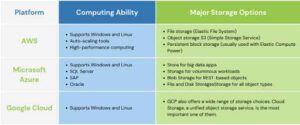
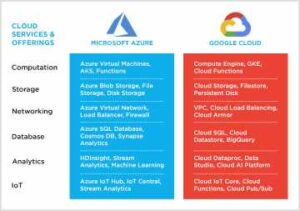
| Service Category | AWS (Amazon Web Services) | Microsoft Azure | Google Cloud (GCP) |
| Compute (Virtual Machines) | Amazon EC2 (Elastic Compute Cloud) | Azure Virtual Machines | Google Compute Engine (GCE) |
| Storage (Object Storage) | Amazon S3 (Simple Storage Service) | Azure Blob Storage | Google Cloud Storage |
| Databases (Managed SQL) | Amazon RDS (Relational Database Service) | Azure SQL Database | Google Cloud SQL |
| Databases (Global NoSQL) | Amazon DynamoDB | Azure Cosmos DB | Google Cloud Spanner / Firestore |
| Containers (Kubernetes) | Amazon EKS (Elastic Kubernetes Service) | Azure Kubernetes Service (AKS) | Google Kubernetes Engine (GKE) |
| Serverless (Functions) | AWS Lambda | Azure Functions | Google Cloud Functions |
| AI / ML Platform | Amazon SageMaker | Azure Machine Learning | Google Vertex AI |
| Hybrid Cloud | AWS Outposts | Azure Arc | Google Anthos |
This table highlights an equivalence between the two services however, the concept of every service differs.
- AWS gives you the broadest range of options (e.g. it has more EC2 instances than any other).
- Azure is the highest combination of features (e.g., Azure SQL Database is a nearly perfect cloud-based version of the SQL Server on premises). SQL Server). 13
- GCP typically provides superior performance in particular regions (e.g., GKE is generally regarded as the most sophisticated Kubernetes service since Google created Kubernetes).
Part 3: The Strategic Battlegrounds – Where the Choice is Won and Lost
An easy feature comparison doesn’t suffice. The ultimate decision is based on four key battlegrounds in which both platforms really diverge.
Battleground 1: AI and Machine Learning
It is the largest battleground in 2025. Generative AI has changed the cloud’s entire worth proposition.
- Google Cloud (GCP): The Innovator and Leader
- The benefit: This is Google’s the home of Google. They’re an AI company first, and a cloud business second. They developed their own “Transformer” architecture (the “T” in ChatGPT) and they have built their own AI-related equipment ( Tensor Processing Units also known as TPUs) They provide huge performance and a cost advantages for training models with large amounts of data. 14
- Key Services Vertex AI is their unifying platform that gives access to the most advanced models such as Gemini.15 Integration with their BigQuery, their data warehouse BigQuery It is seamless, rendering it the top in the field of “data-to-AI” pipelines.
- Select GCP if Your main company involves the field of AI and ML. 16 You have developed next-generation models and you require the best results for training, or are part of a approach to business that is based on analytics.
- Microsoft Azure: The Fast Follower & Enterprise Integrator
- Benefits: Microsoft’s multi-billion dollar investment in OpenAI. Azure provides exclusive, enterprise-grade accessibility to the OpenAI models (like GPT-4) via Azure OpenAI Service. Azure OpenAI Services. 17 This service operates within Azure’s secured, compliant environment. This is an enormous attraction for companies.
- Key Services Azure has embedded “Copilots” (powered by OpenAI) throughout the whole software stack – from GitHub (developer) through Microsoft 365 (office employee) up to Dynamics 365 (sales/ops).
- Select Azure for: You want to implement modern-day Generative Artificial Intelligence to the existing business procedures now. Azure OpenAI is the “out-of-the-box” power of Azure OpenAI as well as its integration to the applications the team is already using are the most powerful feature of Azure OpenAI.
- Amazon Web Services (AWS): The Platform of Choice
- Benefit: Breadth and pragmatism. The AWS strategy doesn’t place all its bets on one model. Their most popular service, Amazon Bedrock is actually the ultimate “model garden. ” 18 It provides access to APIs for models from several firms (Anthropic’s Claude, Stability AI, Cohere, as well as their personal Titan models) all together.
- The Key Service: Bedrock (for simple API accessibility) as well as Amazon SageMaker (the most mature and extensive platform for creating the models, training them, and then deploying your own customized models).19
- Select AWS if You’re looking for the most flexibility. You don’t want to be stuck with an exclusive AI service (like OpenAI or Google) and you want a robust, mature platform (SageMaker) for managing the ML process on your own.
Battleground 2: Hybrid and Multi-Cloud Strategy
There are some things that cannot be moved into the cloud public. The data sovereignty concept, manufacturing with low latency as well as legacy systems require the use of a hybrid strategy.
- Microsoft Azure: The Clear Hybrid Champion 20
- Advantage: Azure Arc. Arc is Azure’s best-planned product. Arc is an all-in-one control plane that allows you to manage your resources wherever–in the data center you have on your premises as well as in AWS or GCP using the identical Azure tools as well as Portal. 21
- Philosophy: “We’ll meet you where you are.” Microsoft realizes that companies are complex and mixed for a number of years. Azure Arc was developed to help extend Azure’s management to extend its management onto your current system. 22
- Select Azure If: You have a large amount of money invested in your Data centers that are on your premises (especially SQL Server and Windows Server) and require a single solution to manage your multi-cloud and hybrid property. 23
- Google Cloud (GCP): The Modern Application Platform
- Advantage: Google Anthos. Anthos is a completely software-based service built upon Google Kubernetes Engine (GKE). 24 Its premise is distinct: “Run Kubernetes everywhere.”
- Philosophy: “Modernize, then distribute.” Anthos isn’t so much concerned with managing legacy servers, and more focused on creating a consistent, modern containers-based system that can operate on any hardware (your server, your data centre AWS, Azure, or at the edges). 25
- Go with GCP when: The hybrid strategy you are using concentrates on developing and installing innovative microservices, containerized applications that are consistent across different platforms. 26
- Amazon Web Services (AWS): The Seamless Extension
- Advantage: AWS Outposts. Outposts is a software-based solution. 27 AWS can literally deliver you one rack AWS servers which you can place into your data center.
- Philosophy: “You’ll get the real AWS, but in your building.” This is not a simulated however it can be described as AWS hardware that runs AWS services that are operated through AWS. 28
- Select AWS If: You have specific tasks which require to remain on site (e.g. high-speed data processing, high-latency data processing or ultra-low latency) However, you’d like the workloads to be completely in sync with AWS services that you utilize within the cloud.
Battleground 3: Data Analytics and Databases
Data is the latest oil cloud platforms are the latest refineries.
- Google Cloud (GCP): The Data Analytics Powerhouse 29
- Advantage: BigQuery. It’s arguably the top cloud data warehouse currently available. It’s not server-based, very quick, and comes with AI/ML integrated. The entire GCP platform is built around a fast global system and culture of information. 30
- Important Services BigQuery (data warehouse), Looker (BI), and Cloud Spanner (a unique, global-distributed database unique in its global scale applications).31
- Go with GCP if Your company’s model is centered around analyzing and processing large amounts of data. It is a company that relies on data which means that your analytics team will require the top-of-the-line software. 32
- Amazon Web Services (AWS): The Most Options
- Benefit: Unmatched breadth. AWS believes that it can provide an “purpose-built database” for every possibility of task. 33
- The Key Services are: Amazon RDS (for standard relational databases), DynamoDB (a hyperscale NoSQL database), Redshift (data warehouse), Neptune (graph database), Timestream (time-series database )…34 The list of options is inexhaustible.
- Select AWS If: You have diverse and unique data requirements. You’re looking for an optimized, efficient solution for each job, instead of a standard solution that is universally applicable.
- Microsoft Azure: The Enterprise Data Estate
- Benefit: Seamless integration for the Microsoft enterprise. 35 The Azure SQL family gives you an unbeatable “lift-and-shift” path for the millions of SQL Server databases that run enterprises today.
- The Key Services are Azure SQL Database, Azure Cosmos DB (a extremely powerful global multi-model database) as well as Azure Synapse Analytics (an connected platform which integrates data warehousing as well as big data analytics).36
- Select Azure for the following reasons: Your company’s data is already invested heavily in Microsoft’s ecosystem (Power BI, SQL Server). Microsoft environment (SQL Server or Power BI). 37 The path to migration is much simpler and the integration process is more thorough.
Battleground 4: Pricing and Cost Management
The process of comparing cloud prices is difficult as the comparison of three distinct, complicated cell plan phone.
- Amazon Web Services (AWS): The Most Complex
- Model AWS is the one with most intricate and detailed pricing. With more than 200 services each having its own unique structure, “bill shock” is the most frequent complaint.
- Savings: It provides many ways of saving money: Reserved Instances (long-term commitments) and savings Plans (more flexible commitments) and Spot Instances (bidding for capacity not used discounts of up to 90%) However, mastering these can be a full-time occupation (hence the rising popularity of FinOps).38
- Review: Potentially the cheapest when you’ve got expert FinOps teams that can optimize the amount you spend. The most costly when you do not.
- Microsoft Azure: The Most Enterprise-Friendly
- Module: Pricing is competitive when compared to AWS. 39
- Save: Azure’s killer discount is the Azure Hybrid Benefit. 40 This lets you reuse your in-house Windows Server and SQL Server licenses on the cloud. This can result in huge savings AWS as well as GCP can’t match.
- Review: The undisputed cost tops the market in the event that you’re a current Microsoft enterprise.
- Google Cloud (GCP): The Most Customer-Friendly 41
- model: Often cited as the most simple and “developer-friendly” pricing. 42
- Saves GCP is the pioneer in Sustained Utilization Discounts that provide automated discounts when you run your workload over a prolonged period. 43 You aren’t required to take any action and the discount will be added. It’s much simpler than the complicated reservation systems of AWS.
- Review: Often the most economical option for companies and startups who want to have a predictable, straightforward pricing with no special FinOps group. 44
Part 4: How to Make Your Final Decision – A Strategic Framework
Cloud computing is not a platform by simply comparing the list of functions. The choice must be according to your business’s specific genetics. You can ask these five questions.
Question 1: What’s your current “Center of Gravity?” (The Path of Least Resistance)
- Are you a “Microsoft Shop? “
- Do you run your business on Windows Server, SQL Server or Active Directory? Do you have a team that is proficient in .NET?
- The most likely option is Microsoft Azure. The integration of your current technology, the reductions resulting of Azure Hybrid Benefit, the cost savings from Azure Hybrid Benefit, and the minimum amount of training required by your employees make it the most cost-effective option.
- Are you an “Open-Source / Linux Shop? “
- Are you using Linux or MySQL/PostgreSQL? Are you using open-source software? Are you a new startup or digital-native business?
- The most likely option is AWS and GCP. AWS has the greatest support as well as the biggest market for open-source. GCP is frequently favored by developers due to its simple modern, contemporary, Kubernetes first approach. 45
Question 2: What’s the “Core Business Superpower?” (The Innovation Engine)
- Does your company get being defined in terms of Data as well as AI?
- Are you battling the capabilities of your algorithms, your data as well as your models for ML?
- The most likely option is Google Cloud. You will require top of the line tools. The blend with BigQuery, Vertex AI, and TPUs are designed to be successful in this field.
- Do you know if your business is described in terms of Scale as well as Breadth?
- Are you an international retailer of e-commerce, a streaming service or multifaceted enterprise with hundreds of apps?
- The most likely option is AWS. You need the largest selection of “purpose-built” tools, the most advanced services, and the biggest global footprint. 46
Question 3: What’s your hybrid/multi-cloud philosophy?
- “We need to manage our existing legacy + cloud. “
- It’s a massive and complex estate on your premises that doesn’t seem to be going out of your sight.
- The most likely option is Microsoft Azure. Azure Arc was specifically designed to handle the “messy enterprise” reality.
- “We need to build modern apps that run anywhere. “
- It is best to use containers for all of your resources and use it in a consistent manner.
- The most likely option is Google Cloud. Google Anthos is the Kubernetes-based solution to this contemporary application approach. 47
- “We need a seamless, low-latency extension of the cloud. “
- It’s all about to be in the authentic cloud. It’s within the data centre of your choice.
- The most likely option is AWS. AWS Outposts is the hardware-based “cloud-in-a-box” solution. 48
Question 4. What are the team’s expertise?
- It is the least-known element. A top-quality platform in the world can be of no use if only person on your team understands what it is and how to use it.
- AWS offers the most talent pool, as well as the highest number of certifications. It’s “easiest” to hire for.
- Azure capabilities have been growing quickly, especially in the current Microsoft IT professional community.
- GCP offers the lowest talent pool yet it’s the most popular for the elite, high-demand groups of data engineers, ML experts and Kubernetes specialists.
5th Question: Have you thought about an Multi-Cloud Strategy?
- The question in 2025 will no longer be “which one?” rather “which ones?”
- A well-established multi-cloud approach is the current norm in large companies. 49 This isn’t about having the same software running on three different clouds, but rather choosing the appropriate cloud for the task at hand.
- An extremely effective and common style we observe:
- Make use of Azure to handle all of your enterprise IT internal as well as identities (Active Directory) and Microsoft 365 workloads. 50
- Make use of HTML0 AWS to run your main customers-facing apps as well as e-commerce platforms and older “lift-and-shift” apps due to the range of services it offers. 51
- Make use of GCP to run the “crown jewel” data analytics and machine learning tasks. 52
Conclusion: The Final Verdict
There isn’t a “best” cloud platform. The best cloud platform that is right for you. Who will win this AWS vs Azure vs Google Cloud contest is one which most matches your company as well as your budget and your goals for strategic planning. 53
- Select AWS If… you require the largest, most comprehensive and the most advanced platform. You appreciate versatility and the ability to build a huge network above all else and have the technological skills to deal with the complexity.
- Select Microsoft Azure when… you have an organization already investing into Microsoft’s ecosystem. Microsoft environment. 54 You require a seamless hybrid cloud option and would like to swiftly implement intelligent AI (OpenAI) in the business processes you already have.
- Select Google Cloud if… your business is founded on data. Your business is competing with AI and machine learning as well as analytics. You need the best technology, with the highest performance for those particular workloads.
The cloud provider you select will be the most crucial supplier for the next 10 years. Don’t make your choice only based on one option or discount for a short time. Choose your option by examining your brand identity and the most enthralling vision you have for the future.
The choice of a cloud-based platform isn’t an easy IT choice. By 2025, it will be the most crucial, high-risk tech and business-related decision an enterprise can take. Your choice of platform is going to become the primary operating system that runs your company, the engine that drives your innovations as well as the safe of your information as well as the underlying structure of your user experience as well as the apex of your security strategy.
The discussion is driven by three hyperscale service providers: they are the “Big Three”: Amazon Web Services (AWS), Microsoft Azure, and Google Cloud Platform (GCP). 1 Each has developed from being a basic service for storage and computing to a vast ecosystem comprising hundreds of sophisticated, robust solutions.
The problem is that On the surface the same, all of them look similar. All offer database virtualization, databases as well as AI services. It’s a false impression that creates a dilemma. An error isn’t just costly, it can also cause your company to be stuck in an entire decade of debt on technical issues or hinder innovation and provide a major advantage over your competition.
This article is intended to make sense of the confusion. This guide will get past the terminology of marketing, and dig into the key differences in strategy that really matter. The 2025 definitive guide for AWS vs Azure vs Google Cloud created not to just compare them however, it will offer a clear guideline for what to consider when you can choose the right cloud that defines the future of your company.
Part 1: The State of the Cloud in 2025 – A Three-Horse Race
Before comparing options, we need to know the market. Cloud infrastructure does not represent a competition between the same kind.
1. Amazon Web Services (AWS): The Incumbent Leader
- Market Share (Approx. 2025): ~31-33%2
- The 10-second pitch: Undisputed leader in the market. They hold the biggest market share, as well as the most extensive and advanced suite of products and services, and also the most active fan base. They’re considered to be the “safe,” default choice.
- the Core Identity AWS can be described as a technology created by engineers specifically for engineers. AWS is an “API-first” company, offering the most comprehensive, extensive range of products. If you can imagine the IT service, AWS has a managed service that can handle it. It is its biggest strengths (infinite adaptability) and also its main complaint (overwhelming complex). 3
2. Microsoft Azure: The Enterprise Challenger
- Market Share (Approx. 2025): ~24-26%
- The 10-Second Pitch The obvious #2 and most rapidly growing enterprise platform. Azure’s biggest strength lies in its integrated, “home-field advantage” with every company already running using Microsoft. 4
- Core Identity Azure is a cloud platform developed by a software firm designed for enterprises. Its primary goal involves seamless interoperability. 5 It’s not just a cloud, It’s an addition to your current Windows Server, SQL Server, Active Directory, and Microsoft 365. 6 For C-suite executives, Azure offers the best path to the least resistance to digital change.
3. Google Cloud Platform (GCP): The Data-Driven Innovator7
- Market Share (Approx. 2025): ~10-12%8
- The 10-Second Pitch The third competitor however, the undisputed leader in AI, Machine Learning (ML) and analysis of data. 9 They are the “developer’s choice” for next-generation applications.
- GCP’s Core Identity GCP is an online platform developed by a company that is a data business and designed to serve the information-driven world.10 Google effectively productized the similar internal infrastructure used to power Search, YouTube, and Maps.11 Its advantage in strategic terms isn’t service breadth but rather, technical proficiency with respect to specific areas of high growth: Kubernetes, AI, as well as big data.12
Part 2: Core Service-to-Service Comparison
Let’s look at into the “building blocks” of each platform. Though the names vary but the fundamental functions remain similar.
| Service Category | AWS (Amazon Web Services) | Microsoft Azure | Google Cloud (GCP) |
| Compute (Virtual Machines) | Amazon EC2 (Elastic Compute Cloud) | Azure Virtual Machines | Google Compute Engine (GCE) |
| Storage (Object Storage) | Amazon S3 (Simple Storage Service) | Azure Blob Storage | Google Cloud Storage |
| Databases (Managed SQL) | Amazon RDS (Relational Database Service) | Azure SQL Database | Google Cloud SQL |
| Databases (Global NoSQL) | Amazon DynamoDB | Azure Cosmos DB | Google Cloud Spanner / Firestore |
| Containers (Kubernetes) | Amazon EKS (Elastic Kubernetes Service) | Azure Kubernetes Service (AKS) | Google Kubernetes Engine (GKE) |
| Serverless (Functions) | AWS Lambda | Azure Functions | Google Cloud Functions |
| AI / ML Platform | Amazon SageMaker | Azure Machine Learning | Google Vertex AI |
| Hybrid Cloud | AWS Outposts | Azure Arc | Google Anthos |
This table highlights an equivalence between the two services however, the concept of every service differs.
- AWS gives you the broadest range of options (e.g. it has more EC2 instances than any other).
- Azure is the highest combination of features (e.g., Azure SQL Database is a nearly perfect cloud-based version of the SQL Server on premises). SQL Server). 13
- GCP typically provides superior performance in particular regions (e.g., GKE is generally regarded as the most sophisticated Kubernetes service since Google created Kubernetes).
Part 3: The Strategic Battlegrounds – Where the Choice is Won and Lost
An easy feature comparison doesn’t suffice. The ultimate decision is based on four key battlegrounds in which both platforms really diverge.
Battleground 1: AI and Machine Learning
It is the largest battleground in 2025. Generative AI has changed the cloud’s entire worth proposition.
- Google Cloud (GCP): The Innovator and Leader
- The benefit: This is Google’s the home of Google. They’re an AI company first, and a cloud business second. They developed their own “Transformer” architecture (the “T” in ChatGPT) and they have built their own AI-related equipment ( Tensor Processing Units also known as TPUs) They provide huge performance and a cost advantages for training models with large amounts of data. 14
- Key Services Vertex AI is their unifying platform that gives access to the most advanced models such as Gemini.15 Integration with their BigQuery, their data warehouse BigQuery It is seamless, rendering it the top in the field of “data-to-AI” pipelines.
- Select GCP if Your main company involves the field of AI and ML. 16 You have developed next-generation models and you require the best results for training, or are part of a approach to business that is based on analytics.
- Microsoft Azure: The Fast Follower & Enterprise Integrator
- Benefits: Microsoft’s multi-billion dollar investment in OpenAI. Azure provides exclusive, enterprise-grade accessibility to the OpenAI models (like GPT-4) via Azure OpenAI Service. Azure OpenAI Services. 17 This service operates within Azure’s secured, compliant environment. This is an enormous attraction for companies.
- Key Services Azure has embedded “Copilots” (powered by OpenAI) throughout the whole software stack – from GitHub (developer) through Microsoft 365 (office employee) up to Dynamics 365 (sales/ops).
- Select Azure for: You want to implement modern-day Generative Artificial Intelligence to the existing business procedures now. Azure OpenAI is the “out-of-the-box” power of Azure OpenAI as well as its integration to the applications the team is already using are the most powerful feature of Azure OpenAI.
- Amazon Web Services (AWS): The Platform of Choice
- Benefit: Breadth and pragmatism. The AWS strategy doesn’t place all its bets on one model. Their most popular service, Amazon Bedrock is actually the ultimate “model garden. ” 18 It provides access to APIs for models from several firms (Anthropic’s Claude, Stability AI, Cohere, as well as their personal Titan models) all together.
- The Key Service: Bedrock (for simple API accessibility) as well as Amazon SageMaker (the most mature and extensive platform for creating the models, training them, and then deploying your own customized models).19
- Select AWS if You’re looking for the most flexibility. You don’t want to be stuck with an exclusive AI service (like OpenAI or Google) and you want a robust, mature platform (SageMaker) for managing the ML process on your own.
Battleground 2: Hybrid and Multi-Cloud Strategy
There are some things that cannot be moved into the cloud public. The data sovereignty concept, manufacturing with low latency as well as legacy systems require the use of a hybrid strategy.
- Microsoft Azure: The Clear Hybrid Champion 20
- Advantage: Azure Arc. Arc is Azure’s best-planned product. Arc is an all-in-one control plane that allows you to manage your resources wherever–in the data center you have on your premises as well as in AWS or GCP using the identical Azure tools as well as Portal. 21
- Philosophy: “We’ll meet you where you are.” Microsoft realizes that companies are complex and mixed for a number of years. Azure Arc was developed to help extend Azure’s management to extend its management onto your current system. 22
- Select Azure If: You have a large amount of money invested in your Data centers that are on your premises (especially SQL Server and Windows Server) and require a single solution to manage your multi-cloud and hybrid property. 23
- Google Cloud (GCP): The Modern Application Platform
- Advantage: Google Anthos. Anthos is a completely software-based service built upon Google Kubernetes Engine (GKE). 24 Its premise is distinct: “Run Kubernetes everywhere.”
- Philosophy: “Modernize, then distribute.” Anthos isn’t so much concerned with managing legacy servers, and more focused on creating a consistent, modern containers-based system that can operate on any hardware (your server, your data centre AWS, Azure, or at the edges). 25
- Go with GCP when: The hybrid strategy you are using concentrates on developing and installing innovative microservices, containerized applications that are consistent across different platforms. 26
- Amazon Web Services (AWS): The Seamless Extension
- Advantage: AWS Outposts. Outposts is a software-based solution. 27 AWS can literally deliver you one rack AWS servers which you can place into your data center.
- Philosophy: “You’ll get the real AWS, but in your building.” This is not a simulated however it can be described as AWS hardware that runs AWS services that are operated through AWS. 28
- Select AWS If: You have specific tasks which require to remain on site (e.g. high-speed data processing, high-latency data processing or ultra-low latency) However, you’d like the workloads to be completely in sync with AWS services that you utilize within the cloud.
Battleground 3: Data Analytics and Databases
Data is the latest oil cloud platforms are the latest refineries.
- Google Cloud (GCP): The Data Analytics Powerhouse 29
- Advantage: BigQuery. It’s arguably the top cloud data warehouse currently available. It’s not server-based, very quick, and comes with AI/ML integrated. The entire GCP platform is built around a fast global system and culture of information. 30
- Important Services BigQuery (data warehouse), Looker (BI), and Cloud Spanner (a unique, global-distributed database unique in its global scale applications).31
- Go with GCP if Your company’s model is centered around analyzing and processing large amounts of data. It is a company that relies on data which means that your analytics team will require the top-of-the-line software. 32
- Amazon Web Services (AWS): The Most Options
- Benefit: Unmatched breadth. AWS believes that it can provide an “purpose-built database” for every possibility of task. 33
- The Key Services are: Amazon RDS (for standard relational databases), DynamoDB (a hyperscale NoSQL database), Redshift (data warehouse), Neptune (graph database), Timestream (time-series database )…34 The list of options is inexhaustible.
- Select AWS If: You have diverse and unique data requirements. You’re looking for an optimized, efficient solution for each job, instead of a standard solution that is universally applicable.
- Microsoft Azure: The Enterprise Data Estate
- Benefit: Seamless integration for the Microsoft enterprise. 35 The Azure SQL family gives you an unbeatable “lift-and-shift” path for the millions of SQL Server databases that run enterprises today.
- The Key Services are Azure SQL Database, Azure Cosmos DB (a extremely powerful global multi-model database) as well as Azure Synapse Analytics (an connected platform which integrates data warehousing as well as big data analytics).36
- Select Azure for the following reasons: Your company’s data is already invested heavily in Microsoft’s ecosystem (Power BI, SQL Server). Microsoft environment (SQL Server or Power BI). 37 The path to migration is much simpler and the integration process is more thorough.
Battleground 4: Pricing and Cost Management
The process of comparing cloud prices is difficult as the comparison of three distinct, complicated cell plan phone.
- Amazon Web Services (AWS): The Most Complex
- Model AWS is the one with most intricate and detailed pricing. With more than 200 services each having its own unique structure, “bill shock” is the most frequent complaint.
- Savings: It provides many ways of saving money: Reserved Instances (long-term commitments) and savings Plans (more flexible commitments) and Spot Instances (bidding for capacity not used discounts of up to 90%) However, mastering these can be a full-time occupation (hence the rising popularity of FinOps).38
- Review: Potentially the cheapest when you’ve got expert FinOps teams that can optimize the amount you spend. The most costly when you do not.
- Microsoft Azure: The Most Enterprise-Friendly
- Module: Pricing is competitive when compared to AWS. 39
- Save: Azure’s killer discount is the Azure Hybrid Benefit. 40 This lets you reuse your in-house Windows Server and SQL Server licenses on the cloud. This can result in huge savings AWS as well as GCP can’t match.
- Review: The undisputed cost tops the market in the event that you’re a current Microsoft enterprise.
- Google Cloud (GCP): The Most Customer-Friendly 41
- model: Often cited as the most simple and “developer-friendly” pricing. 42
- Saves GCP is the pioneer in Sustained Utilization Discounts that provide automated discounts when you run your workload over a prolonged period. 43 You aren’t required to take any action and the discount will be added. It’s much simpler than the complicated reservation systems of AWS.
- Review: Often the most economical option for companies and startups who want to have a predictable, straightforward pricing with no special FinOps group. 44
Part 4: How to Make Your Final Decision – A Strategic Framework
Cloud computing is not a platform by simply comparing the list of functions. The choice must be according to your business’s specific genetics. You can ask these five questions.
Question 1: What’s your current “Center of Gravity?” (The Path of Least Resistance)
- Are you a “Microsoft Shop? “
- Do you run your business on Windows Server, SQL Server or Active Directory? Do you have a team that is proficient in .NET?
- The most likely option is Microsoft Azure. The integration of your current technology, the reductions resulting of Azure Hybrid Benefit, the cost savings from Azure Hybrid Benefit, and the minimum amount of training required by your employees make it the most cost-effective option.
- Are you an “Open-Source / Linux Shop? “
- Are you using Linux or MySQL/PostgreSQL? Are you using open-source software? Are you a new startup or digital-native business?
- The most likely option is AWS and GCP. AWS has the greatest support as well as the biggest market for open-source. GCP is frequently favored by developers due to its simple modern, contemporary, Kubernetes first approach. 45
Question 2: What’s the “Core Business Superpower?” (The Innovation Engine)
- Does your company get being defined in terms of Data as well as AI?
- Are you battling the capabilities of your algorithms, your data as well as your models for ML?
- The most likely option is Google Cloud. You will require top of the line tools. The blend with BigQuery, Vertex AI, and TPUs are designed to be successful in this field.
- Do you know if your business is described in terms of Scale as well as Breadth?
- Are you an international retailer of e-commerce, a streaming service or multifaceted enterprise with hundreds of apps?
- The most likely option is AWS. You need the largest selection of “purpose-built” tools, the most advanced services, and the biggest global footprint. 46
Question 3: What’s your hybrid/multi-cloud philosophy?
- “We need to manage our existing legacy + cloud. “
- It’s a massive and complex estate on your premises that doesn’t seem to be going out of your sight.
- The most likely option is Microsoft Azure. Azure Arc was specifically designed to handle the “messy enterprise” reality.
- “We need to build modern apps that run anywhere. “
- It is best to use containers for all of your resources and use it in a consistent manner.
- The most likely option is Google Cloud. Google Anthos is the Kubernetes-based solution to this contemporary application approach. 47
- “We need a seamless, low-latency extension of the cloud. “
- It’s all about to be in the authentic cloud. It’s within the data centre of your choice.
- The most likely option is AWS. AWS Outposts is the hardware-based “cloud-in-a-box” solution. 48
Question 4. What are the team’s expertise?
- It is the least-known element. A top-quality platform in the world can be of no use if only person on your team understands what it is and how to use it.
- AWS offers the most talent pool, as well as the highest number of certifications. It’s “easiest” to hire for.
- Azure capabilities have been growing quickly, especially in the current Microsoft IT professional community.
- GCP offers the lowest talent pool yet it’s the most popular for the elite, high-demand groups of data engineers, ML experts and Kubernetes specialists.
5th Question: Have you thought about an Multi-Cloud Strategy?
- The question in 2025 will no longer be “which one?” rather “which ones?”
- A well-established multi-cloud approach is the current norm in large companies. 49 This isn’t about having the same software running on three different clouds, but rather choosing the appropriate cloud for the task at hand.
- An extremely effective and common style we observe:
- Make use of Azure to handle all of your enterprise IT internal as well as identities (Active Directory) and Microsoft 365 workloads. 50
- Make use of HTML0 AWS to run your main customers-facing apps as well as e-commerce platforms and older “lift-and-shift” apps due to the range of services it offers. 51
- Make use of GCP to run the “crown jewel” data analytics and machine learning tasks. 52
Conclusion: The Final Verdict
There isn’t a “best” cloud platform. The best cloud platform that is right for you. Who will win this AWS vs Azure vs Google Cloud contest is one which most matches your company as well as your budget and your goals for strategic planning. 53
- Select AWS If… you require the largest, most comprehensive and the most advanced platform. You appreciate versatility and the ability to build a huge network above all else and have the technological skills to deal with the complexity.
- Select Microsoft Azure when… you have an organization already investing into Microsoft’s ecosystem. Microsoft environment. 54 You require a seamless hybrid cloud option and would like to swiftly implement intelligent AI (OpenAI) in the business processes you already have.
- Select Google Cloud if… your business is founded on data. Your business is competing with AI and machine learning as well as analytics. You need the best technology, with the highest performance for those particular workloads.
The cloud provider you select will be the most crucial supplier for the next 10 years. Don’t make your choice only based on one option or discount for a short time. Choose your option by examining your brand identity and the most enthralling vision you have for the future.